About
gta6x — GTA VI package explorer
Explore a local GTA VI package, extract assets, and inspect its metadata from the command line. Export textures, audio, video and shaders, or build a searchable asset browser without decrypting the archive index.
The native toolkit uses Python's standard library and opens package data read-only. No installation or build step is required. Optional tools add model and world exports, and supported audio-to-WAV conversion.
Capabilities
| Area | What you can do |
|---|---|
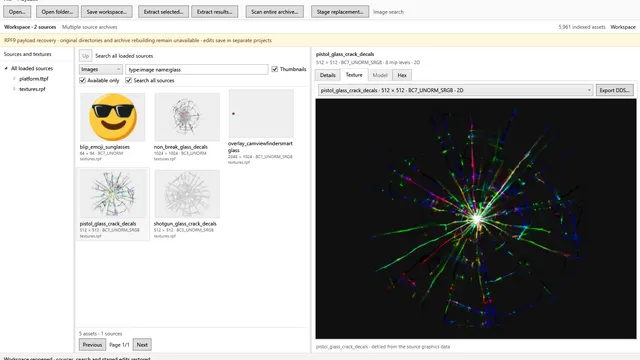
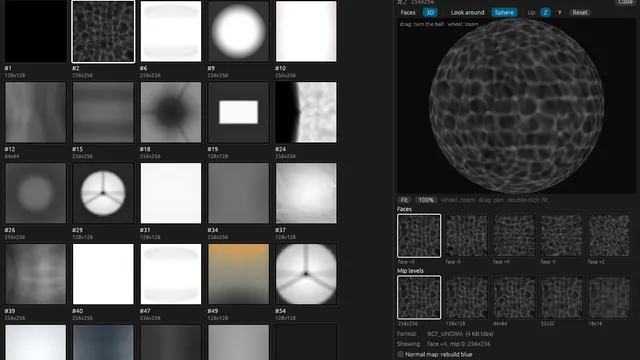
| Textures | List streamed and embedded textures; export supported mip chains, arrays and cubemaps to DDS; generate PNG previews, including BC1–BC7. Inspect DDS files and export selected planes without re-encoding. |
| Audio and music | Inspect archived or extracted AWC streams and music channels; extract native payloads; remux supported Opus to playable Ogg; export supported WAV audio with libopus. Browse audio-config records and TRACKID chapter metadata. |
| Radio libraries | Extract researched stations with named, tagged files; build portable VLC playlists, continuous broadcasts, chapter splits, CUE sheets and marker sidecars. Includes a bundled song/station name-and-hash catalog. |
| Video | Find Bink2 movies, inspect dimensions and duration, and extract the original files. |
| Metadata | Browse PSIN schemas, enums, supported instance values and record links; compare extracted schema declarations; export JSON and recover complete XML/PSIN resources. |
| Shaders | Extract DXBC binaries; inspect signatures and features; query logical resource bindings by stage, register, space and type. |
| Animation | List names and clips; inspect extracted resource metadata, native bone tables, packed buffers, binding keys and raw code rows; compare skeleton records, trace supported key-holder chains and browse MoVE/RBF metadata. |
| Native world inspection | Browse level-resource schemas and blocks, inspect supported primitive storage, trace checked local references and export their DOT graphs. |
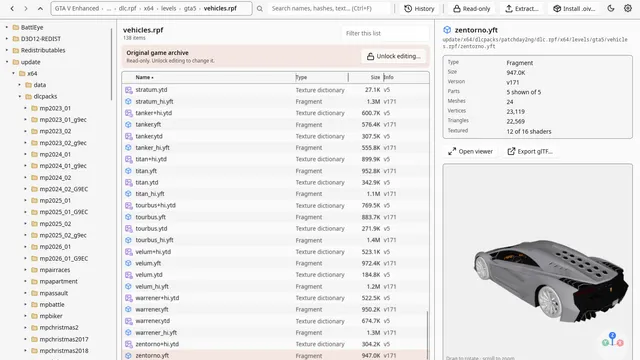
| Asset browsing | Build JSON or SQLite catalogs, generate a searchable HTML browser, retrieve individual assets and use an interactive terminal browser. |
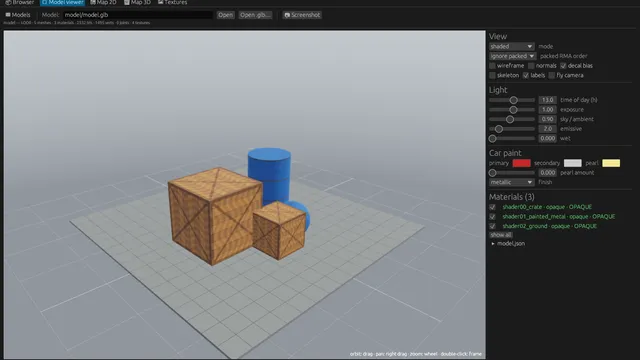
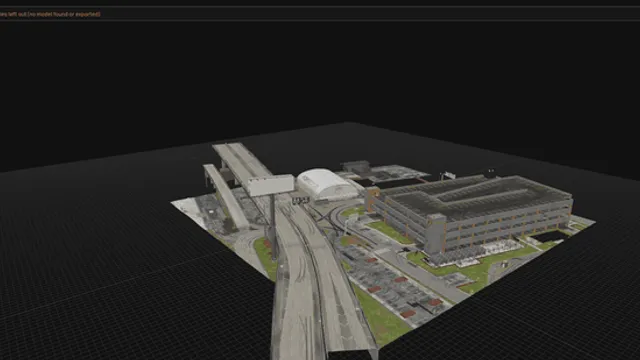
| 3D exports | Export models to glTF/GLB and world data such as placements, collision, navmeshes and paths through the optional SixNG backend. |
Quick start
You need Python 3.10+ and a local, readable package. Run commands from this checkout's root directory; no third-party Python packages are required.
export GTA6_ROOT="/path/to/gta6"

python3 -m gta6x info
python3 -m gta6x textures --max 20
python3 -m gta6x --help
You can pass --root PATH instead of setting GTA6_ROOT. Global options go
before the command:
python3 -m gta6x --root "$GTA6_ROOT" --json info
python3 -m gta6x textures --help
The general syntax is python3 -m gta6x [--root PATH] [--json] COMMAND [OPTIONS].
Use COMMAND --help for its full options. Archive and pool filters usually
accept name fragments, such as levels or vehicles.
Common workflows
Textures
List a pool, export DDS files with PNG previews, or inspect embedded textures:
python3 -m gta6x textures --pool vehicles --max 20
python3 -m gta6x textures --pool vehicles --max 20 --out ./exports/textures --png
python3 -m gta6x textures --embedded --archive textures --max 20 --out ./exports/embedded --png
Add --bcpack to attempt native BC1/BC3/BC4/BC5 BCPack decoding, or --all to
remove the texture-count limit. Filter with --hash-prefix or --min-size.
--png-mip, --png-slice and --png-z select a supported preview subresource;
DDS retains the supported texture layout. textures.json records exports and
skip reasons. Textures without recovered names retain their hash identifiers.
Audio and video
python3 -m gta6x awc --archive audio --limit 64 --max 10
python3 -m gta6x awc --archive audio --limit 64 --ogg-out ./exports/audio
python3 -m gta6x awc --archive audio --limit 64 --music-out ./exports/music
python3 -m gta6x movies --archive movies --limit 64 --out ./exports/movies
For supported PCM WAV export, install a compatible libopus system library
and use --wav-out or --music-wav-out. Raw and Ogg export need no audio library.
Use music --config for audio-config browsing and awc --radio for native
markers and TRACKID chapters.
Radio libraries and VLC playlists
Install FFmpeg and ffprobe, then export the bundled stations or select a station by name:
python3 -m gta6x radio --list
python3 -m gta6x radio --list-credits --station "The Vault Radio"
python3 -m gta6x radio --out ./exports/radio
python3 -m gta6x radio --station "Flash FM" --out ./exports/flash-fm
python3 -m gta6x radio --station "The Sniper of La Perle" --out ./exports/sniper
python3 -m gta6x radio --list-tracks --station "Flash FM"
python3 -m gta6x radio --names-out ./radio-names.json
Open playlists/All Stations.m3u8 or an individual station playlist in VLC.
Default Opus exports preserve compressed audio; --format flac, mp3, m4a
or wav converts explicitly. Broadcasts include native marker/seek metadata;
native intervals support chapter files, embedded Opus chapters and CUE. Shows
without native song boundaries provide stored program audio and separately tagged
identification excerpts. Mapped broadcast song cuts provide longer song sections
in the main station and All Stations playlists, as well as separate song-cut
playlists, retaining DJ transitions and provisional boundary labels.
Identified-location playlists jump into the program and continue playback. Bundled
standalone recordings for premixed stations have their own standalone/ folder
and (standalone tracks) playlist, separate from broadcast chapters. Bundled
acoustic and user-supplied credits name supported Vault, Worldwide, Radio
On-U and Sniper chapter occurrences, including artist tags and explicit Song A → Song B (transition) labels for
audited overlaps. Unmatched intervals retain their TRACKIDs. Copy cuts follow
packet boundaries;
--exact-chapters re-encodes interval cuts on the selected audio timeline.
Talk stations are included; --include-imaging adds station beds and imaging.
Named bonus playlists are listed separately from station groups. Conflicting
fingerprint credits remain available as alternatives to the selected display metadata.
Matched classical recordings can carry separate performer and composer tags;
--song also searches those composer credits.
Liquid City performances recovered from spoken show segments export as provisional
broadcast cuts, with the original show segments in a separate playlist.
Bonus Tracks collects identified recordings whose original station or use is unknown.
--audio-dir DIR reuses addressed Opus extractions; source-bound recording and
chapter credits require native archive input. Matching files and sidecar hashes permit
safe reruns; changed settings or conflicting files require
--overwrite. The bundled catalog preserves research
provenance and conflicting credits; it needs no files from exports/ or work/.
--list-credits also browses public song lists whose audio remains unidentified.
Fuller public credits supply display metadata while JSON retains alternatives
and provisional matching evidence. Public list order never names
unknown TRACKID intervals.
Metadata, shaders and animation
python3 -m gta6x psin --archive levels --schema --out schemas.json
python3 -m gta6x psin --archive levels --instances --record-graph --out instances.json
python3 -m gta6x shaders --metadata --out ./exports/shaders
python3 -m gta6x --json shaders --bindings --binding-type 3 --max 10
python3 -m gta6x anim --resources --clips --out ./exports/animations
python3 -m gta6x world --kind resources --schemas --extract-resources --out ./exports/world
PSIN supports local name dictionaries and cross-file schema registries.
Use --find-field, --find-type or --same-layout; add --registry-only --registry FILE
for offline queries. --context-record BLOCK:RECORD traces checked record links.
Inspect paths with --context-field BLOCK:RECORD:FIELD[.FIELD...] or --field-tree;
--context-map and --context-enum inspect selected map and enum evidence.
--context-pool and --pool-incoming BLOCK:RECORD trace storage and incoming evidence.
--hash-use WORD finds opaque-word usages; --typed-hash-candidates --names names.json
adds candidate names without asset bindings. --graph-dot FILE exports checked graphs;
--type5c-spans checks spans; --type5c-graph adds candidate links.
--type5c-diagnostics explains unresolved headers, coverage gaps and missing targets.
--type5c-pool-context compares candidate spans with existing reference-pool users.
psin --manifest FILE queries verified exports; --manifest-limit selects a prefix.
Native world inspection traces supported direct and fixed-embedded references
with --links, including supported container entries and counted-value pool
references. Pool grouping requires complete coverage; keys and value meanings
remain unknown. Use --primitive-layouts, --reference-context
and --context-record BLOCK:RECORD for the supported storage views. Bound scans with
--start, --scan-mib and --max-nodes; --extent-diagnostics reports gaps
and missing declared bytes. --extract-resources exports complete checked PSIN
files and skips unknown boundaries. To inspect an extracted file directly, use
--raw-resources --archive FILE; raw inputs are never carved or joined.
--manifest FILE verifies and inspects a batch from a native export manifest.
Add --value-words to inspect raw primitive bits and full key slots; it implies
--links. Use --names FILE for verified hash-preimage candidates whose native
meanings remain unconfirmed.
--graph-dot FILE exports checked reference ranges as a source-scoped graph;
it implies --links. Large graphs may need a higher --max-nodes budget.
Add --graph-record SOURCE:BLOCK:RECORD to show direct incoming and outgoing
ranges for selected records; repeat the option to select more than one.
For animation research, anim --binding-layout traces raw binding keys to
slot-directory entries and checks local animation-dictionary membership,
identifier hashes and member buckets.
anim --sample-codes exports conditional raw row codes
and packed entry bits; use --out DIR to save JSON and --max-nodes N to set
the output budget. Numeric samples, poses, timing and bone bindings remain
unresolved.
anim --key-holders inspects supported native key-holder and parent references
in archives or with --raw-resource; archive mode implies --resources.
Use --max-nodes to set the inspection budget;
bone and rig meanings remain unconfirmed.
For a decompressed native pack stream, anim --raw-skeleton FILE inspects bone
names, stored keys and parent/sibling/subtree relationships. Add --bone-keys
to compare alternate keys with the fitted name formula, or --pose-layout for
checked parallel records and raw numeric word views. --out DIR saves
skeleton.json. Unexplained keys, pose meanings and animation-to-skeleton
ownership remain explicit.
--skeleton-context adds local reference paths, active zero-key context and
quaternion/matrix consistency checks. Bound the expanded inspection with
--max-nodes; larger tables may need a higher budget.
Use --provider-targets to trace supported nested references, or --bone-names
to inspect the compact name-to-bone-index lookup.
Add --skeleton-dot FILE to export the checked stored-parent forest as a DOT
graph; pose and animation ownership remain unconfirmed.
Inspect selected rows from an extracted packed buffer using its parent metadata's binding count:
python3 -m gta6x --json anim --raw-buffer packed.bin --binding-count 64 \
  --sample-source 0 --sample-rows 0:4
Shader --binding-stage, --binding-space, --binding-register and
--binding-type filter reported declarations. These describe logical registers;
game texture and material identities remain unknown.
Work with extracted files
Inspect assets without scanning the game archives:
python3 -m gta6x dds texture.dds --dds-out selected.dds --png preview.png
python3 -m gta6x awc --raw bank.awc --out bank.json
python3 -m gta6x awc --raw bank.awc --stream-index 0 --tag-index 1 --chunk-out payload.bin
python3 -m gta6x awc --raw clip.awc --stream-index 0 --ogg-file clip.opus
python3 -m gta6x --json shaders --raw shader.cso --bindings
python3 -m gta6x psin-diff before.psin after.psin --out comparison.json
python3 -m gta6x anim-diff before.0drp after.0drp --out declarations.json
python3 -m gta6x skeleton-diff first.bin second.bin --out skeleton-comparison.json
python3 -m gta6x --json anim --raw-resource extracted.0drp --out ./exports/metadata
python3 -m gta6x world --kind resources --raw-resources --archive level.bin \
  --out ./exports/world --graph-dot ./exports/world/links.dot --max-nodes 300000
DDS inspection supports tightly packed DX10 layouts, legacy DXT1/3/5 and supported
BC4/BC5 FourCCs, and exact RGBA8/BGRA8/BGRX8 mask layouts.
Preview selectors are --mip, --slice and --z
where the layout permits them; the same selectors apply to lossless --dds-out
export. awc --raw accepts whole container files, with optional --radio views
and ordered --source-sha256 pins. --chunk-out extracts exact stored bytes by
stream/tag ordinal from one container; the result is not decoded audio.
For standalone mono 48 kHz Opus, --ogg-file remuxes unchanged packets using
declared duration. --ogg-pre-skip overrides the conventional 312-sample default;
the original alignment remains unconfirmed.
Repeat anim --raw-resource FILE to inspect a
batch; --expected-sha256 pins each input in order. This reads bounded native
0DRP metadata without scanning archives or joining files.
Add --find-structure, --find-field, --find-type, --find-aux or --find-size
to query native declarations; --find-enum selects a separate enum query.
anim-diff compares complete stored structure and enum declarations, retaining
unknown words and ambiguous matches. It reports literal differences without
claiming schema compatibility.
skeleton-diff compares checked named records and stored parent links; name
alignment is a candidate, with pose and rig compatibility unconfirmed.
Raw shader mode accepts multiple files and writes inspection JSON
with --out DIR. PSIN comparison preserves unknowns and ambiguous declarations;
matching hashes do not establish semantic compatibility.
Catalog and browse assets
python3 -m gta6x catalog --archive levels --limit 64 --db gta6.db
python3 -m gta6x browse --db gta6.db --out ./site
python3 -m gta6x tui --db gta6.db
Open site/index.html to browse the catalog. Use get to extract a cataloged
asset by hash or archive offset. Catalogs can also be written as JSON; report
generates Markdown or HTML inventories.
Models and world exports with SixNG
Provide a SixNG executable, either through
GTA6X_SIXNG or --backend PATH. It is a separate optional dependency and is
not bundled; Rust is only needed if you build it yourself.
export GTA6X_SIXNG="/path/to/sixng"

python3 -m gta6x models index --archive packs
python3 -m gta6x models extract --archive packs --max 5 --out ./exports/models
python3 -m gta6x world --via sixng --kind placements --archive levels --out ./exports/placements
Backend indexes are cached in .sixng-work/. models list previews available
entries. Other world export kinds include collision, navmesh, paths,
lights and interiors. Backend results depend on SixNG's format support and
may be incomplete. world --kind resources uses the native reader instead.
More commands
| Commands | Purpose |
|---|---|
info, headers, resources |
Inspect package identity, archive headers and texture-pool indexes. |
scan, extract, zlib |
Find media carriers or carve compressed resource streams. |
structured, rbf, move |
Recover XML/PSIN resources or inspect supported RBF and MoVE metadata. |
names build, names lookup |
Build or query a local name-hash dictionary. |
get, hunt |
Retrieve cataloged assets or identify geometry-like byte patterns. |
report, verify |
Generate inventories or check a SHA-256 manifest. |
selftest |
Run built-in parser checks without game data. |
For scan-based commands, --limit generally sets MiB per archive and --full
scans the whole archive where supported. Display limits such as --max do not
necessarily cap extraction. Native world uses --scan-mib for scan size and
--limit for resource count; check each command's help before a large export.
Current limits
- Archive access: the RPF9 index is not decrypted. Resource scanning and carving do not provide a complete original filename tree.
- Textures: some formats and layouts remain unsupported, including native compressed or multi-mip volume export. BCPack coverage is partial: BC3/BC4/BC5 reject unknown histories and warn on provisional entries; BC1 retains legacy preset fallbacks. BC6H/BC7 BCPack is unsupported.
- Audio: XMA2 decoding and some Opus timing/skip profiles are unsupported. Native song-title, station-membership and playlist links remain unresolved.
- Animation and world: native inspection exposes metadata and checked storage relationships, not decoded animation curves, placements or geometry. Asset bindings, transform meanings and semantic ownership remain unconfirmed.
Unsupported cases are reported with reasons. Exported data goes to the paths you choose; no game data, keys or external executables are included here.
License and credits
MIT License. Copyright (c) 2026 HolyRoses. Third-party decoder attributions and license details are in THIRD_PARTY_NOTICES.md.
Thanks to SixNG, rpf9-explorer, Leonida, and the GTA modding community for their tools and format research. SixNG and external BCPack helpers are optional, separate tools; their code is not bundled.
Versions
- 8f0d3afcurrent25 Nov 2026Download 8f0d3af
Source code at this commit. The repository has no packaged release.